 713-662-3123
Coroplast signs are signs printed on corrugated plastic, a fluted polypropylene sheet that looks and cuts like plastic cardboard. Coroplast is actually a brand name, the same way Kleenex is, and it has become the everyday word for the material behind almost every yard sign in Houston and beyond.
Why does the material matter? Because signs do real work. In a FedEx Office survey, 76% of American consumers said they had entered a store they’d never visited before based on its signs (FedEx Office, 2012). After 80 years of printing signs in Houston, we can tell you the cheapest way to put that effect in front of traffic is a sheet of coroplast on a wire stake. This guide covers what the material is, every standard size, your options, and how to order.
Key Takeaways
- Coroplast is an extruded polypropylene copolymer sheet, chemically inert and unaffected by water (Coroplast).
- Nine standard sizes run from 12×9 inches to 48×48 inches.
- UV protection is an optional additive, so ask before you buy.
- The material is 100% recyclable, and volume pricing at our store drops the per-sign cost as quantities rise.
Ready to print? Shop coroplast yard signs at our online store with instant pricing, nine sizes, and design templates.
What Is Coroplast?
Coroplast is an extruded, high-impact polypropylene copolymer sheet. According to the manufacturer, the material is chemically inert with a neutral (NIL) pH, and most oils, solvents, and water have no effect on it, which lets it perform under adverse weather conditions (Coroplast, Product Properties).
Picture cardboard, then replace the paper with plastic. That’s the structure. Two flat plastic faces are joined by vertical ribs called flutes, and those flutes create air channels that make the sheet stiff without making it heavy. The flat faces take full-color print cleanly, while the hollow core keeps shipping costs and installation effort low.
The chemistry is the quiet advantage. Paper-based signs absorb water and fail. Coroplast doesn’t absorb anything. Rain runs off, humidity passes through the flutes, and the sheet stays flat and legible. For a city that spends half the year in Gulf Coast humidity, that trait alone explains a lot of the material’s popularity here.
You’ll hear other names for the same product: corrugated plastic, fluted polypropylene, twin-wall plastic, or the generic “plastic cardboard.” At the counter, we hear all of them weekly. They all describe the sheet we use for corrugated plastic yard letters and standard yard signs alike.
Why Is Coroplast the Standard for Yard Signs?
Signage quality shapes buying behavior. In the same FedEx Office survey, 68% of consumers said a store’s signage reflects the quality of its products or services, and 52% said they’re less willing to enter a store with misspelled or poorly made signs (FedEx Office, 2012). Coroplast delivers a clean, professional print at the lowest cost per square foot of any rigid sign material we stock.
Three qualities made it the default.
It’s light. A crew member can carry a stack of signs under one arm. Wire stakes push into soil by hand, no tools, no concrete, no permits for most private-property placements. That’s why real estate agents, contractors, and campaigns all standardized on it. Our real estate sign customers routinely install a listing sign in under a minute.
It handles typical outdoor conditions. Our store describes the product as lightweight yet durable enough to handle typical outdoor conditions like wind, rain, and sun exposure. In Houston terms: afternoon downpours, brutal late-summer heat, and the gusty fronts that blow through during hurricane season. Because the sheet is chemically inert and water has no effect on it (Coroplast), a soaked sign dries out and keeps working.
It’s cheap enough to deploy in volume. Yard signs work as a numbers game. A University of Cincinnati study found businesses that changed or improved their signage reported roughly 10% increases in sales, profits, and transactions (Economics Center, University of Cincinnati, 2012). Coroplast lets a small budget put a message on twenty corners instead of one. Political campaign signs rely on exactly that math.
For a broader look at choosing yard signs by use case, our new yard signs buyer’s guide goes deeper on all of this.
What Sizes Are Available?
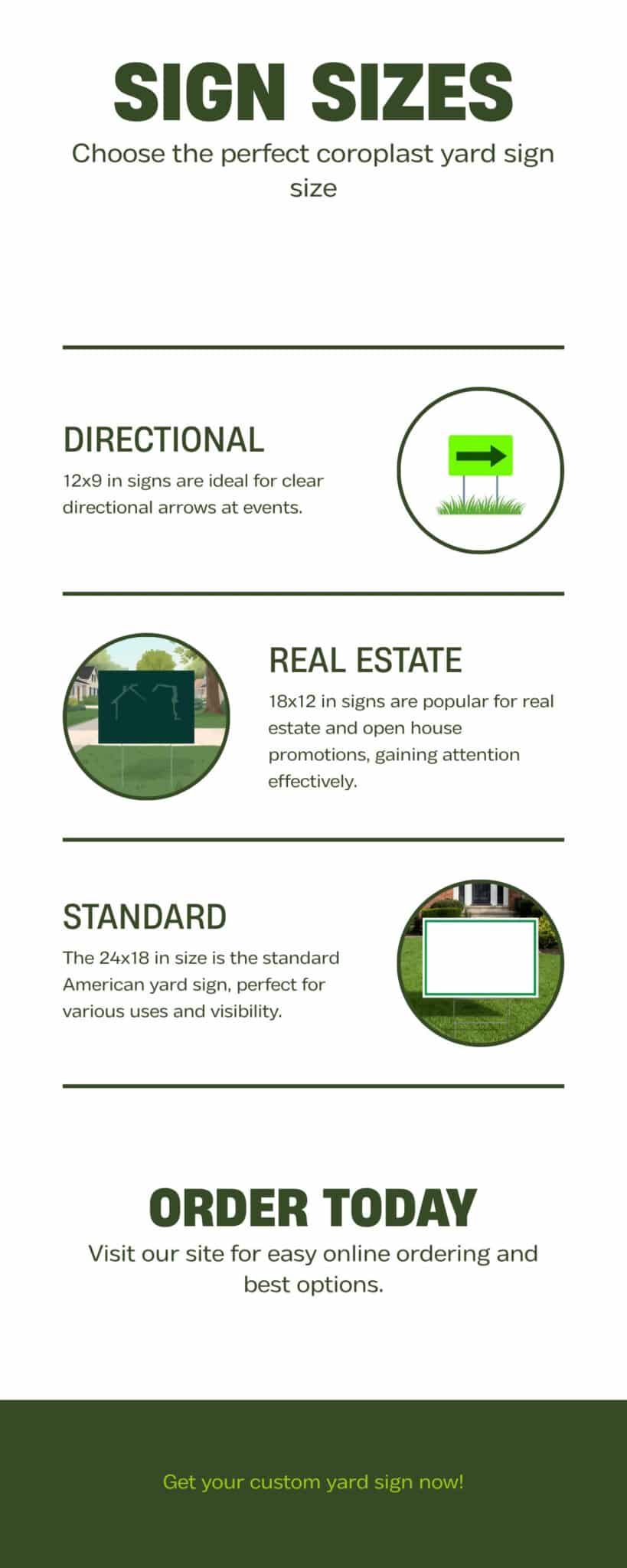
Our online store stocks nine standard coroplast sign sizes, from a 12×9-inch directional sign (108 square inches) up to a 48×48-inch job site sign (2,304 square inches). That’s more than a 21x spread in printed area, which is why matching size to viewing distance matters more than any other design decision.
Here’s the full lineup with the uses we see most often:
| Size (inches) | Printed area (sq in) | Common uses |
|---|---|---|
| 12×9 | 108 | Directional arrows, parking, small notices |
| 12×12 | 144 | Square directional and event markers |
| 24×6 | 144 | Real estate rider strips (“Sold,” agent phone) |
| 18×12 | 216 | Classic real estate and open house signs |
| 24×16 | 384 | Larger campaign and promo signs |
| 24×18 | 432 | The standard American yard sign |
| 24×24 | 576 | Square event and graduation yard signs |
| 36×24 | 864 | Contractor and business promotion signs |
| 48×48 | 2,304 | Job site, construction, and development signs |
If you’re not sure, buy 24×18. It’s the size drivers expect, it fits standard wire stakes, and it reads clearly from a residential street. Go bigger only when your audience moves faster or sits farther away.
The chart below shows how dramatically printed area scales across the nine sizes:
Need a size that isn’t listed? Call us at 713-662-3123 for custom dimensions and quantities.
Single vs Double Sided, Cut Style, and Mounting Options
Every coroplast sign order comes down to four choices: single or double sided printing, square or contour cut, wire stakes or grommets, and quantity. Our online store prices each configuration live, with volume pricing that drops the per-sign cost as quantity climbs.

Single or double sided?
Ask one question: will people approach the sign from both directions? A sign staked perpendicular to a street gets read by traffic moving both ways, so double sided pays for itself. A sign flat against a fence or building only ever shows one face. Real estate signs and campaign signs are almost always double sided. Event directionals usually aren’t.
Square cut or contour cut?
Square cut is the standard rectangle, and it’s what stakes and frames are built for. Contour cut trims the sheet to a custom shape: an arrow, a house outline, a logo silhouette. Contour cuts grab attention but cost more and may need custom mounting. For most buyers, square cut is the right call.
Wire stakes or grommets?
Wire stakes are H-shaped frames that slide into the sign’s flutes and push into soil. They’re the classic lawn setup, and they’re an add-on at checkout. Grommets are metal rings punched into the corners so you can zip-tie or screw the sign to fences, posts, or scaffolding. Going on grass? Stakes. Going on a chain-link fence at a job site? Grommets. One practical Houston note: after a week of summer rain softens the ground, push stakes fully to the crossbar so gusty afternoon storms can’t lever the sign loose.
Is Your Coroplast UV-Stabilized? The Question Most Buyers Skip
This is the nuance almost nobody asks about. According to the manufacturer, UV protection in coroplast is an optional additive blended into the sheet on request, not a standard feature of all corrugated plastic (Coroplast, Product Properties). Two signs that look identical at the counter can weather very differently in the sun.
Why does this matter in Houston more than most places? Our sun is relentless. A sign facing south on an unshaded esplanade takes a beating that a shaded porch sign never sees. Inks fade first, then unstabilized plastic can grow brittle. So before you buy from any printer, ask a simple question: is this stock UV-stabilized?
We’re happy to answer it, and we’d extend the same advice to any exterior signage purchase. For long campaigns through a full Gulf Coast summer, confirm the stock. For a weekend garage sale, don’t sweat it.
Can Coroplast Signs Be Recycled?
Yes. Coroplast material is 100% recyclable, according to the manufacturer’s own packaging documentation (Coroplast, Packaging). Since the sheet is polypropylene, a retired sign doesn’t have to end up in a landfill.
There’s a better option than recycling, though: reuse. Coroplast blanks are famously handy. Customers tell us their old signs become garage shelf liners, paint shields, pet crate panels, and school project boards. Campaigns flip expired signs and repaint them for the next race. Our birthday yard sign and letter customers often store and re-stake the same set for years of family celebrations.
One caveat. Curbside programs vary by municipality, and some sorting facilities reject fluted sheet even when the resin is accepted. Check locally before you toss a stack in the blue bin.
How Do You Order Coroplast Signs Online?
Two paths, one storefront. At our online store you can either upload a print-ready design or build your sign from scratch in the Designer Studio, which includes ready-made templates. Either way, the cart prices your exact configuration, shows volume discounts, and estimates shipping by zip code.
The walkthrough:
- Pick your size. All nine standard sizes are listed on the yard sign product page.
- Choose options. Square or contour cut, single or double sided, wire stakes or grommets.
- Add your artwork. Upload a print-ready file, or open the Designer Studio and start from a template. The Studio path works well if you don’t have a designer; type your text, drop in a logo, done.
- Set quantity and check shipping. Enter your zip code for a shipping estimate, or arrange pickup at our shop at 5801 Chimney Rock Rd.
- Check out. Most orders take under ten minutes start to finish.
Need something outside the standard menu? Custom sizes and large quantities go through our quote form or a call to 713-662-3123. And if you’re still weighing materials, our companion post comparing coroplast vs other sign materials breaks down when aluminum, foam board, or a vinyl banner beats corrugated plastic.
Frequently Asked Questions About Coroplast Signs
What is coroplast made of?
Coroplast is an extruded high-impact polypropylene copolymer, formed as a twin-wall fluted sheet (Coroplast). It’s chemically inert with a neutral pH, and most oils, solvents, and water have no effect on it, which is why it holds up outdoors.
Are coroplast signs waterproof?
Effectively, yes. Water has no effect on the polypropylene sheet itself (Coroplast), so rain and humidity won’t warp or dissolve it the way they destroy paper or foam board. Quality outdoor inks keep the printed graphics weather-ready too.
How long do coroplast signs last outside?
It depends on sun exposure, wind, and whether the stock is UV-stabilized, so we won’t quote you a fake number. Signs in shade outlast signs in full southern sun. For long deployments through a Houston summer, ask for UV-stabilized stock and check stakes after storms.
What is the most popular coroplast sign size?
24×18 inches is the standard American yard sign, and it’s the size we print most. It reads well from residential streets, fits standard wire stakes, and keeps costs low. Faster traffic or longer viewing distances call for 36×24 or the 48×48 job site size.
Can you print on both sides of a coroplast sign?
Yes. Double sided printing is a checkbox option at our online store. Choose it whenever traffic approaches from two directions, which covers most staked yard, real estate, and campaign signs. Fence-mounted signs viewed from one side can stay single sided and save money.
Do coroplast signs come with stakes?
Wire stakes are an add-on rather than an automatic inclusion, so select them at checkout if your signs are going into the ground. If you’re mounting to a fence or post instead, add grommets. Ordering both keeps your options open for mixed placements.
How much do coroplast signs cost?
Our store prices each coroplast sign by configuration, with volume pricing that lowers the per-sign price on larger quantities. Size, double sided printing, contour cutting, and add-ons like stakes or grommets all move the final number. Shipping is estimated by zip code in the cart.
Are coroplast signs good for political campaigns?
Very. A randomized field study across four races led by a Columbia University team found lawn signs increase a candidate’s vote share by about 1.7 percentage points on average (Green et al., Electoral Studies, 2016). Coroplast’s low cost makes that district-wide coverage affordable.
The Bottom Line
Coroplast earned its place as the yard sign standard honestly: a chemically inert, water-shrugging polypropylene sheet that’s light enough to install by hand, cheap enough to buy by the dozen, and 100% recyclable when it retires. Know your size, decide on sides and mounting, and ask the UV question before a long summer run.
We’ve been printing signs for Houston since 1946, and coroplast remains the fastest, most affordable way to put a message on the ground. Ready to order? Shop coroplast yard signs with instant online pricing, or browse all products in our store to see what else corrugated plastic can do. Questions first? Call 713-662-3123 and talk to the counter.