 713-662-3123
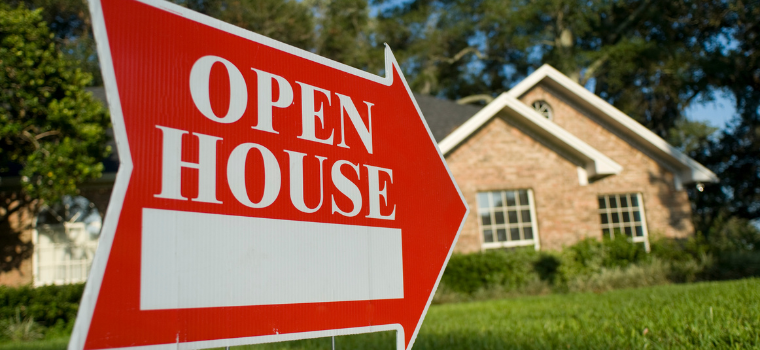
An open house does not run on one yard sign. It runs on a small kit: one sign at the property, one at every turn between the nearest major road and the front door, one at each extra way into the neighborhood, and two spares in the trunk. For most Houston listings that lands between four and seven coroplast signs. The route sets the number. The price of the house does not.
Agents who lose Saturday traffic almost never lose it at the curb. They lose it three blocks out, at the turn nobody marked.
Key Takeaways
- Count decision points, not houses. One sign at the property, one per turn, one per extra neighborhood entrance, two spares. Most Houston listings need four to seven.
- Build a kit, not a one-off print. Reusable arrows plus one listing-specific panel beats reprinting the whole set for every address, and it survives the next listing too.
- The public right-of-way is not yours. Since September 2025 Texas caps the civil penalty for an unauthorized right-of-way sign at $1,000, $2,500, and $5,000 for a first, second, and third violation.
- Handing the mallet to an assistant does not move the liability. Texas now defines “person” in that chapter to include a person’s employee, agent, and independent contractor. The same 2025 act did drop the old per-day penalty accrual.
- TREC rules follow the face. Advertisements need the license holder or team name plus the broker’s name at half size. A directional sign carrying only the broker’s name or logo sits outside that definition.
- Order the whole kit at once. One file setup, one run, one shipment, configured on the yard sign product page.
How many yard signs does one Houston open house need?
Count every turn a stranger has to make from the nearest major road to your front door, add one sign per turn, one at the property, one at each additional way into the neighborhood, and two spares. That total is your kit. For most Houston listings it comes to four to seven signs.
Run the count from the buyer’s seat, not from your own. You already know the route. They are following a map app that says “turn right on Bissonnet” and then goes quiet for four blocks while they watch for a driveway they have never seen. Every point where the app goes quiet and the buyer has to choose is a place where a sign earns its cost.
The four parts of the count:
- One sign at the property. Front yard, aimed at the direction most traffic arrives from.
- One sign at each turn between the nearest arterial and the listing.
- One sign at each additional entrance if the neighborhood has more than one way in. Master-planned sections in Katy, Cypress, and Pearland routinely have two or three, and a third entrance pushes the kit to eight.
- Two spares. Signs walk off, get mowed over, and get knocked flat by an afternoon storm. Spares turn a ruined Saturday into a five-minute fix.
Write the count down for each neighborhood you work. The second time you list in that section of Sienna, the kit is already sized, and you order it in a minute instead of rebuilding the plan from scratch on a Wednesday night.
Sign sizes that fit each job in the kit
Give the property sign the biggest panel you can stake cleanly. Give each directional sign enough panel to hold one arrow and one word. Coroplast yard signs come in fixed sizes, so design to those dimensions rather than asking for a custom cut you do not need.
| Job in the kit | Size that fits it | Why |
|---|---|---|
| Property sign in the front yard | 24×18 or 36×24 | Read from a moving car, and carries branding plus required text without crowding |
| Directional arrow at a turn | 18×12 or 24×18 | One arrow, one word. Bigger panels here mainly buy reading distance on a faster street |
| Rider strip above or below a sign | 24×6 | Holds the changing detail: the date, the time, or the word “Today” |
| Small tag near a walkway or door | 12×9 or 12×12 | Close-range instructions like “Sign in here” or “Shoes off, please” |
| Entrance sign on an arterial road | 24×24 or 36×24 | Traffic moves faster, so the panel has to carry taller type |
Two configuration choices decide how well the kit performs. Wire stakes are what let you aim a sign, and they are a separate line on the order. Grommets are for hanging on a fence or a rail, which is a different job. Whether a given sign should be printed on one face or two comes down to how many directions traffic reaches it from, and our guide to single-sided versus double-sided yard signs works that out at a specific address. If you are still settling on dimensions, the yard signs buyer’s guide lays out the full size range.
Where Texas law lets you stake an open house sign
On the listing itself with the seller’s permission, and on other private property only with that owner’s permission. Not in the public right-of-way. The esplanade, the strip of grass between sidewalk and curb, the median, the utility pole, and the traffic sign post are all off the table, and the exposure is not theoretical.
Texas rewrote this in 2025. House Bill 3611, passed by the House on April 30 and the Senate on May 19 and effective September 1, 2025, amended Section 393.007 of the Transportation Code. A person who places or commissions the placement of a sign on the right-of-way of a public road that is not otherwise authorized by law, or whose commercial advertisement is on that sign, may be liable for a civil penalty. For a first violation the political subdivision has to give written notice and a period to remove the sign before the penalty attaches. After that, the penalty may not exceed $1,000 for a first violation, $2,500 for a second, and $5,000 for a third or subsequent one. A municipal, district, or county attorney can sue to collect it.
One piece of that rewrite runs in your favor. The old statute let a separate penalty be collected for every day a violation continued, and House Bill 3611 struck that language out. A sign you leave up by accident is no longer a meter running against you.
The rest of it does not run in your favor. The same act added a definition of “person” to that chapter, and it includes “a person’s employee, agent, independent contractor, assignee, business alter ego, and successor in interest.” Read that twice. Sending an assistant out with the arrows does not move the exposure off your name. Neither does hiring a sign service.
Citation capsule: H.B. 3611, 89th Texas Legislature, effective September 1, 2025, amended Transportation Code Section 393.007 so the civil penalty “may not exceed” $1,000 for a first violation, $2,500 for a second, and $5,000 for a third or subsequent violation, with a written notice and removal period required before a first-violation penalty. The enrolled text also strikes the prior provision that “a separate penalty may be collected for each day a continuing violation occurs,” and adds a definition of “person” in Section 393.001 that includes “a person’s employee, agent, independent contractor, assignee, business alter ego, and successor in interest.” Source: H.B. No. 3611, enrolled text, Texas Legislature Online.
Houston enforces this at volume. A 2021 Texas Senate Research Center analysis reported that the City of Houston “confiscates an average of 3,174 bandit signs, issues 25 citations, and receives 87 reports of signs per month.” That figure is five years old and it came from a bill that died in committee, so treat it as a picture of scale rather than a current count. The scale is the point. A city pulling thousands of signs a month is not going to make an exception for a nice open house arrow.
Citation capsule: The Senate Research Center’s analysis of C.S.S.B. 355 (87th Legislature, 2021) reported that Houston confiscates roughly 3,174 bandit signs, issues 25 citations, and receives 87 sign reports per month. That bill’s last recorded action was a committee report sent to Calendars, so its proposed $10,000 penalty never took effect. Source: Texas Senate Research Center, Bill Analysis, C.S.S.B. 355.
Then there is your license. The Texas Real Estate Commission is direct about where the responsibility sits: “although TREC does not regulate where a license holder places a sign, a license holder is responsible for compliance with any rules, restrictions, or regulations covering placement of a sign in their local area.” TREC goes further and warns that placing signs in violation of a city ordinance “could be considered an act of negligence or incompetence that authorizes disciplinary action against the license holder as well as subject the license holder and possibly even their principal to enforcement actions by the appropriate authorities.”
Citation capsule: TREC states that it does not regulate sign placement, that the license holder is responsible for local rules, and that placement in violation of a city ordinance could support disciplinary action against the license holder and their principal. Source: Texas Real Estate Commission, Frequently Asked Questions.
Deed restrictions usually bind before the city does
Note the word “restrictions” in that TREC sentence. Much of the Houston area is governed by deed restrictions and HOA rules rather than by zoning, and those documents frequently limit sign size, sign count, how long a sign may stay up, and whether any sign at all may sit on common area or at a subdivision entrance. In the master-planned communities named above, the entrance monument and the landscaped median at the front of the section are almost always association property, which means the association decides, not the city and not the corner homeowner.
Two minutes of prevention: pull the community’s governing documents or email the association manager once, then keep the answer in your notes for that neighborhood so you never have to ask twice. Ask specifically about signs on common area, signs at the entrance, and any time window for weekend signage. A yes in writing beats an apology later.
The old workaround still works everywhere else: ask. A corner homeowner, a church, or a strip center will often say yes to one sign for four hours. Get the yes, put the sign on their grass, pull it when you leave. Our earlier guide on where to place open house signs covers the sightline side of the same decision.
What Texas requires on the face of an open house sign
Any sign that advertises you needs the license holder or team name plus the broker’s name at a minimum size. A pure directional arrow carrying only the broker’s name or logo is treated differently. That distinction shapes how you design the kit.
TREC Rule 535.155 requires each advertisement to include, in a readily noticeable location, “the name of the license holder or team placing the advertisement” and “the broker’s name in at least half the size of the largest contact information for any sales agent, associated broker, or team name contained in the advertisement.” The rule’s definition of advertisement expressly covers “displays, signs and billboards.”
The same rule then carves out what an advertisement does not include: “a directional sign that may also contain only the broker’s name or logo.” A plain arrow sign with nothing on it but OPEN HOUSE, the arrow, and the brokerage logo is outside the definition. Add your photo, your cell number, your team name, or a QR code pointing at your own site, and it is an advertisement again. The broker name then has to be sized accordingly.
Citation capsule: 22 TAC Section 535.155(a) requires the license holder or team name plus the broker’s name at least half the size of the largest agent, associated broker, or team contact information. Section 535.155(b)(1) defines advertisement to include signs, and excludes “a directional sign that may also contain only the broker’s name or logo.” Sources: TREC’s Advertising Rules and the full text of 22 Tex. Admin. Code Section 535.155.
The design consequence is clean. Keep the arrows minimal and reusable. Put your face, your number, and your team branding on the property sign, where you have the panel space to size the broker name correctly anyway.
Reusable arrows plus one listing-specific panel
Split the kit. Print the arrows once and reuse them for years. Print only the property panel and the rider per listing. This is the largest cost difference between agents who run open houses every weekend and agents who reprint a full set every time.

What belongs on the reusable half:
- The arrow and the words OPEN HOUSE
- The brokerage logo or broker name, and nothing else, so the sign stays a directional sign under the TREC carve-out
- High-contrast color that reads at speed
What belongs on the per-listing half:
- Address, time, and any listing-specific hook, on the property sign
- The changing detail on a 24×6 rider, so the main panel survives into the next listing
- Your contact information, sized against the broker name
Print the arrows in a quantity that covers your worst route, not your average one. If your busiest section needs six arrows, order eight. A kit that is one arrow short on a Saturday morning fails at exactly the turn where you needed it.
For a large book of listings, we also run site sign management programs that track placements, removals, and relocations. That is the version of this problem that stops being solvable out of a trunk. Details are on our Houston real estate signs page.
Coroplast holds up to a Houston open house weekend
Easily, and that is the point of the material. Coroplast is the brand name for extruded twinwall corrugated plastic sheet made from a high impact polypropylene copolymer. A Coroplast product overview published by the distributor Professional Plastics describes the sheet as chemically inert with a NIL pH factor, and notes that at regular temperatures “most oils, solvents and water have no effect, allowing it to perform under adverse weather conditions.” The sheet is produced in gauges from 2mm to 10mm, and ultraviolet protection is one of the additives that can be melt-blended into it.
Citation capsule: A Coroplast product overview describes the sheet as a high impact polypropylene copolymer that is chemically inert with a NIL pH factor, where “most oils, solvents and water have no effect,” extruded in gauges from 2mm to 10mm with UV protection available as a melt-blended additive. Source: Coroplast Overview and Product Details, published by distributor Professional Plastics.
On our side of it, we print open house directional signs with UV fade-resistant inks. A sign that works a full spring of Saturdays in Houston sun will show fading long before the panel itself gives out, so the ink is what determines how many seasons a reusable arrow lasts. Two habits extend that life. Pull the signs the same day instead of leaving them out all week, because sun and wind do their damage while nobody is watching. Store them flat rather than leaning in a garage corner, because a warped panel never sits square on a stake again.
One note on how the panel is built, since it affects the stake. The flutes run in one direction through the sheet, and wire stake legs slide into those flutes. We orient the flutes to match the way the sign will be staked, which is why it helps to tell us the signs are going on stakes when you order rather than after the fact. For a fuller comparison of how materials behave in this climate, see our breakdown of weatherproof materials for custom yard signs in Houston.
How to order the whole kit at once
Set the size first, then quantity, then cut type, sides, stakes, and grommets. Do it once for the arrows and once for the property panel. Both runs live on the same coroplast yard sign product page, where each choice is a dropdown and the running total updates as you change it. You can estimate shipping by ZIP code before you commit. Pricing moves with size, quantity, and options, so check the live number on the product page rather than working from an old quote.
Artwork goes in one of two ways. Upload a print-ready file, or build the design in the online Designer Studio. Set up both files, the arrow and the property panel, before you start the order, and you will not find yourself rebuilding artwork halfway through checkout. Our guide to ordering custom yard signs online without mistakes covers bleed, safe margins, and the file traps that cause a reprint.
Timing is the part agents underestimate. Our published average from concept to completion on residential real estate signage is 2 to 7 business days, listed on our real estate signs page. A listing that goes live Thursday for a Sunday open house is not a print job, it is a scramble. Order the reusable arrows once, ahead of any specific address, and keep them in the trunk. For a size or a quantity the store does not list, or for a franchise-standard package with riders and frames, call 713-662-3123 or email info@houstonsign.com.
Houston Sign Company has printed signs in this city since 1946, out of 5801 Chimney Rock Rd. We have watched a lot of open houses lose their traffic three blocks from the door, at a turn that one more arrow out of the same print run would have covered. We have never once seen that happen to an agent who counted the turns first.
Frequently Asked Questions
How many open house signs do I need for one listing?
Count the turns a stranger has to make between the nearest major road and the listing, then add one sign per turn, one at the property, one at each additional neighborhood entrance, and two spares. Most Houston listings land between four and seven signs. A cul-de-sac off a main street needs about four. A master-planned section with three turns and a second entrance needs about seven.
Can I put open house signs on the esplanade or the median in Houston?
No. Those are public right-of-way. Texas Transportation Code Section 393.007, as amended by House Bill 3611 effective September 1, 2025, sets civil penalties for signs placed on the right-of-way of a public road that are not otherwise authorized by law, capped at $1,000 for a first violation, $2,500 for a second, and $5,000 for a third or subsequent one, after a written notice and a chance to remove the sign on a first violation. Place signs on the listing or on private property with the owner’s permission instead, and check the neighborhood’s deed restrictions before using common area.
Does an open house directional arrow need my broker’s name on it?
It depends on what else is on it. TREC Rule 535.155 excludes from the definition of advertisement “a directional sign that may also contain only the broker’s name or logo.” An arrow carrying nothing but OPEN HOUSE and the brokerage logo falls outside the rule. Add your photo, phone number, team name, or a QR code and it becomes an advertisement, which then needs the license holder or team name plus the broker’s name at least half the size of the largest agent or team contact information.
What size yard sign works best for open house directional signs?
18×12 and 24×18 handle most directional signs, since they only need to carry an arrow and one word. Step up to 24×24 or 36×24 at a subdivision entrance on a faster road, where taller type is doing the work. Reserve 24×6 for rider strips that carry the changing detail like the date or the word “Today.”
Should open house signs be single sided or double sided?
Match the number of printed faces to the number of directions traffic reaches the sign from. A directional sign at an intersection is read from both legs, which argues for two faces. A sign backed against a fence or at the closed end of a cul-de-sac only needs one. On a corner, two single-sided signs aimed independently often beat one double-sided sign, because the two approach paths are rarely exactly opposite.
How long do coroplast open house signs last in Houston weather?
The panel outlasts the print. Coroplast is a polypropylene copolymer twinwall sheet that is chemically inert and unaffected by water at normal temperatures, so rain and humidity are not what kill it. Sun is. Printing with UV fade-resistant inks, pulling the signs the same day instead of leaving them out all week, and storing them flat will keep a reusable set of arrows working for many seasons.
How far ahead should I order open house signs?
Our published average from concept to completion on residential real estate signage is 2 to 7 business days, so a Thursday listing with a Sunday open house is too tight for a fresh print. Order the reusable arrows once, ahead of any specific listing, and keep them in the trunk. Then only the property panel and the rider need to be printed per address.
Sources
- H.B. No. 3611, 89th Texas Legislature, enrolled text (amends Transportation Code Sections 393.001 and 393.007, effective September 1, 2025)
- Texas Senate Research Center, Bill Analysis, C.S.S.B. 355, 87th Legislature (the bill did not become law)
- Texas Real Estate Commission, TREC’s Advertising Rules (Rule 535.155)
- Texas Real Estate Commission, Frequently Asked Questions (sign placement)
- 22 Tex. Admin. Code Section 535.155, Advertisements (Cornell Legal Information Institute)
- Coroplast Overview and Product Details (published by distributor Professional Plastics)