 713-662-3123
Buy a double-sided yard sign when traffic reaches the sign from two directions, and a single-sided sign when it reaches the sign from one. That is the whole decision. A corner lot, a two-way residential street, a median-divided approach, or a walkway people pass in both directions all earn the second face. A sign backed against a fence, a wall, a window, or the closed end of a cul-de-sac does not, and paying for a face nobody will ever stand in front of is money that could have bought more signs instead.
Everything else in this guide is about telling those two situations apart quickly, at a real address, without guessing.
Key Takeaways
- Count approach directions, not sides. One direction of travel calls for one face. Two calls for two.
- Corner lots almost always need two faces. Two streets means two approach paths, and each one deserves a sign facing it.
- The back of a single-sided sign is blank, and blank is not neutral. Drivers coming the other way get nothing for the entire approach.
- Texas puts required text on the sign. Real estate advertising must carry the broker’s name at a minimum size, and political signs must carry a highway right-of-way notice that state guidance allows on the reverse side.
- Sides is a print decision, not a material decision. Coroplast sheet arrives surface treated on both faces, so the second side costs one more press pass on the same panel.
- Both options live on the same product page. Sides is a dropdown on the yard sign product page, next to size, quantity, cut type, stakes, and grommets.
Single-sided vs double-sided at a glance
The two options differ in coverage and layout, not in durability or material. Here is the whole comparison in one place.
| Single sided | Double sided | |
|---|---|---|
| Coverage | One approach direction | Two opposing approach directions |
| What you pay for | One printed face | A second printed face on the same panel |
| Durability | Same panel, same weather life | Same panel, same weather life |
| Best placements | Fence, wall, window, cul-de-sac, bulk directional runs | Corner lots, two-way streets, medians, sidewalks |
| Aiming | Free to angle the one face exactly where you want it | Faces are locked 180 degrees apart |
| Layout constraint | All required text competes for one surface | Required text can move to the back, freeing the front |
| Watch out for | Losing half the street without realizing it | Heavy ink on one face ghosting through to a light face on the other |
What actually changes when you add the second side?
Only the printing changes. The panel stays the same. A double-sided coroplast yard sign is the same sheet of corrugated plastic in the same size and thickness, imaged on both faces instead of one. You are not buying a thicker sign, a stiffer sign, or a longer-lasting sign. You are buying a second readable surface.
That matters for how you budget. The second face costs you ink and one more press pass on a panel you were already buying, and the manufacturer of the material has already done the prep work for it. Coroplast, the corrugated plastic sheet brand used across the sign industry, states in its converting documentation that "Both surfaces are treated full width to accept certain types of inks and adhesives." Both sides of the sheet arrive at the printer ready to hold ink. Nothing about the material has to change to print the back.
Citation capsule: Under its surface treatment section (Corona Discharge), Coroplast states: "Both surfaces are treated full width to accept certain types of inks and adhesives." A separate section on the same page adds that "Coroplast is a polyolefin copolymer," a nonabsorbent material that requires inks formulated for it. Source: Coroplast, General Conversion Information.
One design consequence worth knowing before you approve a proof. Because the sheet is thin, a heavily inked dark face can ghost faintly through to a light face on the other side. If one face is solid navy and the other is white with thin type, ask to see a proof of both faces together rather than one at a time.
The practical read for a listing agent: if you are already committed to a coroplast sign, adding the second side is an incremental cost on a per-sign basis. If you are not sure you need it, the honest comparison is between one double-sided sign and more single-sided signs for the same spend.
When is a double-sided yard sign worth it?
Whenever a person can approach the sign from two different directions and you want both of them to read it. Federal guidance for traffic signs states the principle plainly. The Manual on Uniform Traffic Control Devices, the FHWA publication that governs public road signs nationwide, advises in Section 2A.17 that "signs should be vertically mounted at right angles to the direction of, and facing, the traffic that they are intended to serve."
A sign face serves the traffic it faces. That is what engineers design to, and it is what your yard sign obeys whether you plan for it or not. If your listing sits on a two-way street and your sign faces north, southbound drivers spend the entire approach looking at the back of a blank panel.
Citation capsule: FHWA guidance directs that signs be mounted at right angles to, and facing, the traffic they are intended to serve, and that on curved alignments placement follow the direction of approaching traffic rather than the roadway edge. This appears under Guidance, meaning "should" rather than "shall." Source: MUTCD 11th Edition, Chapter 2A, Section 2A.17.
Situations that reliably earn the second face:
- Corner lots. Two streets, two approach paths. In our experience this is the most common case we see on Houston residential listings.
- Two-way residential streets. Half your traffic is coming the other way. On a single-sided sign, that half sees nothing.
- Open house directional signs at intersections. A directional sign at a turn is read by cars on both legs of the intersection.
- Divided or median-separated roads. Traffic on the far side reads the sign from the opposite bearing.
- Sidewalk and walkway placements. Foot traffic moves in both directions and moves slowly enough to actually read.
- Campaign signs on neighborhood through streets. Political signs are placed to be seen by everyone who passes, not by one direction of travel.
When is a single-sided yard sign the better buy?
When the sign has a back that nobody can stand behind, or when your budget buys more coverage than it buys more faces. These cases are legitimate, common, and frequently the smarter call.
- Backed placements. Against a fence, a wall, a hedge, a building, or inside a window, the reverse face is physically unviewable.
- Dead-end streets and cul-de-sacs. Traffic arrives from one direction and leaves the same way.
- Bulk directional runs. If you are staking a route of arrows to an open house, each arrow serves one approach. Ten single-sided arrows cover more turns than five double-sided ones.
- Interior and event placements. Registration tables, booth signs, and hallway markers usually face a fixed direction.
- Short-run promotions where reach beats depth. For a weekend event, more sign locations usually outperform more faces per location.
There is a quiet third option worth naming. For a corner lot, two single-sided signs staked at different angles can outperform one double-sided sign, because you control the aiming of each face independently. A double-sided sign forces the two faces to sit exactly 180 degrees apart. Two separate signs do not. When the two approach paths are not opposite each other, which is normal at a corner, independent aiming wins.
How do you decide at a specific address? The drive-by test
Stand where the sign will go, then count the directions a person can arrive from and still be looking at that spot. That count is how many faces you need. It takes about a minute and it beats any rule of thumb.
Run it in this order:
- Walk to the stake point. Not the curb, the actual spot in the yard.
- Look up each direction of travel. Note every direction a car or a pedestrian can approach from.
- For each direction, ask whether the sign would be facing them or away. A face aimed 90 degrees off still reads at an angle. A face aimed 180 degrees off reads as a blank rectangle.
- Subtract blocked approaches. Parked cars, a hedge, a mailbox cluster, or a neighbor’s tree can kill an approach that looks open on paper.
- Count what is left. One live approach calls for single sided. Two or more calls for double sided, or for two single-sided signs aimed independently.
How much reading time does a driver actually get?
Here is where the second face earns or loses its keep. FHWA guidance in Section 2A.08 of the MUTCD sets a floor for legibility: "A minimum specific ratio of 1 inch of letter height per 30 feet of legibility distance should be used."
Apply that to a yard sign. Three-inch type is legible from roughly 90 feet. A car doing 30 miles per hour covers 44 feet every second. So a driver approaching a sign with 3 inch type gets about two seconds of usable reading time, and that is if the sign is facing them the entire way. If it is not, they get their two seconds in the rear-view mirror, after they have already passed the house.
That arithmetic is why the sides question is really a coverage question. Larger type extends the distance a facing driver can read from. A second face is the only thing that helps the driver who is not facing you.
What do Texas rules put on each face?
Required text follows the face that carries your name. Two Texas rules bear directly on what a yard sign has to say, and both of them change how you lay out a double-sided design.
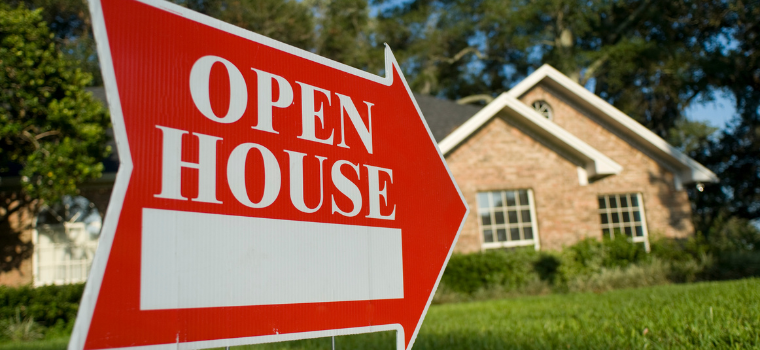
Real estate signs. The Texas Real Estate Commission answers the sign question directly. Under the heading "What is the required information that must be provided in advertisements such as signs, email and business cards?", TREC states that "Rule 535.155 requires each advertisement to include the following items in a readily noticeable location in the advertisement":
- "The name of the license holder or team placing the advertisement; and
- The broker’s name in at least half the size of the largest contact information for any sales agent, associated broker, or team name contained in the advertisement."
TREC’s rules define an advertisement to include "displays, signs and billboards."
The practical consequence, and this is our reading rather than a rule TREC has written about sign faces: if your name appears on both faces of a double-sided listing sign, the safe assumption is that the broker name belongs on both faces too, at no smaller than half the size of the largest agent, associated broker, or team contact information on that face. Treat each printed face as its own advertisement and you will not have to argue the point.
Citation capsule: TREC requires each advertisement to carry the license holder or team name plus the broker’s name at least half the size of the largest sales agent, associated broker, or team contact information, and its advertisement definition covers signs. Source: Texas Real Estate Commission, TREC’s Advertising Rules.
TREC also notes that while it does not regulate where you place a sign, "a license holder is responsible for compliance with any rules, restrictions, or regulations covering placement of a sign in their local area," and that sign ordinances typically prohibit placing a sign on a utility pole, a traffic signal box, or in a road median. Worth checking before you plan a median placement that would otherwise be a textbook double-sided location.
Campaign signs. Texas requires political advertising signs to carry a highway right-of-way notice, verbatim: "NOTICE: IT IS A VIOLATION OF STATE LAW (CHAPTERS 392 AND 393, TRANSPORTATION CODE), TO PLACE THIS SIGN IN THE RIGHT-OF-WAY OF A HIGHWAY." The Texas Ethics Commission’s published guidance adds a detail that matters here: "The highway right-of-way notice may appear on the reverse-side of a sign."
That is a genuine argument for a second face on a campaign sign. On a single-sided sign the notice competes with the candidate’s name for space on the only surface you have. On a double-sided sign you can hold one clean layout on the front and place the notice where it does not fight the message. If you are ordering political signs this cycle, our 2026 Texas campaign sign playbook walks through the rest of the rules, and the campaign sign product page carries the same single- or double-sided option.
Citation capsule: Texas political advertising rules require a verbatim highway right-of-way notice on political advertising signs, and state guidance permits that notice to appear on the reverse side. Source: Texas Ethics Commission, Political Advertising.
How sides interact with size, cut, stakes, and grommets
Sides is one of several choices on the same order form, and the others affect how well the second face performs. On our store, a coroplast yard sign is configured by size, quantity, cut type, sides, wire stakes, and grommets.
| Choice | Options in the store | What it means for the sides decision |
|---|---|---|
| Size | 12×9, 12×12, 18×12, 24×6, 24×16, 24×18, 24×24, 36×24, 48×48 inches | Bigger panels carry bigger type, which extends legibility distance on whichever face is aimed correctly |
| Type | Square cut or contour cut | Contour cut reads as a silhouette from both approaches, which pairs well with two faces |
| Sides | Single sided or double sided | The coverage decision this guide is about |
| Wire stakes | With or without, available at additional cost | Stakes let you aim a sign, and two staked single-sided signs can beat one double-sided sign on a corner |
| Grommets | With or without | Grommets are for hanging on fence or rail, which is usually a one-face situation |
A few pairings worth knowing:
- Double sided plus wire stakes is the standard corner-lot listing configuration.
- Single sided plus grommets is the standard fence-mount or rail-mount configuration, because a mounted sign has no viewable back.
- 24×18 double sided is the workhorse for residential listings, large enough for readable type at street distance and small enough to stake cleanly.
- 24×6 single sided works as a rider strip, where the sign is attached to a frame or a larger panel.
If you are still deciding on size and material before you get to sides, the yard signs buyer’s guide covers dimensions and ordering, and the coroplast buyer’s guide covers how the material behaves outdoors. For Houston-specific weather questions, our breakdown of weatherproof yard sign materials is the place to start.
How to order the exact configuration you need
Pick the size first, then sides, then stakes, then quantity. That order keeps you from re-deciding. On the yard sign product page, each of those is a dropdown, the running total updates as you change them, and you can estimate shipping by entering a ZIP code before you commit.
Two ways to supply artwork: upload a print-ready file, or build the design in the online Designer Studio. If you want the faces to differ, say a listing side and a QR or contact side, set up both files before you start the order so you are not re-uploading mid-flow. Our guide to ordering custom yard signs online without mistakes covers the file setup details.
For a size or quantity the store does not list, or for a franchise-standard real estate package with riders and frames, call 713-662-3123 or email info@houstonsign.com. Our real estate signs page covers riders, open house signs, and the site sign management program that tracks placements, removals, and relocations across a book of listings. That page also puts the average timeline from concept to completion on custom signage work at 2 to 7 business days, which is worth knowing when a listing goes live on a Thursday.
Houston Sign Company opened in downtown Houston in 1946 and prints today out of 5801 Chimney Rock Rd. We have watched a lot of agents pay for faces that pointed at a fence, and a lot of others lose the northbound half of a street because one sign faced south. The sides dropdown is a small choice with a real consequence, and it is worth the sixty seconds it takes to stand at the stake point and count.
Frequently Asked Questions
Are double-sided yard signs twice the price of single-sided?
No. The second side adds one more printed face to the same panel. The sheet, the cut, the stake, and the shipping weight all stay effectively the same. Because pricing moves with size, quantity, and options, check the live number on the yard sign product page, where the total updates as you set sides and quantity.
Is a double-sided coroplast sign more durable than a single-sided one?
No. Durability comes from the material, the thickness, and the mounting. The number of printed faces has no bearing on it, and both options are the same corrugated plastic panel. If you need longer outdoor life, change the material or the mounting.
Do I need double-sided signs for a corner lot?
Usually yes, and sometimes two single-sided signs are better. A corner has two approach paths, so one face is not enough. If those two paths are not directly opposite each other, two separate single-sided signs let you aim each face at its own street, which a double-sided sign cannot do.
Can the front and back of a double-sided sign be different designs?
Yes. The two faces are printed independently, so you can run a listing message on one and a directional arrow, contact block, or QR code on the other. Supply both files when you place the order, and ask to see a proof of both faces together so you can check for ink showing through a light-colored face.
What has to appear on a real estate yard sign in Texas?
TREC requires each advertisement to include the name of the license holder or team placing it, plus the broker’s name at least half the size of the largest contact information for any sales agent, associated broker, or team name in that advertisement. TREC’s advertisement definition covers signs. On a double-sided sign, the safe practice is to treat each printed face as its own advertisement.
Where does the political advertising notice go on a campaign sign?
Texas requires the highway right-of-way notice verbatim on political advertising signs, and the Texas Ethics Commission states the notice may appear on the reverse side of a sign. On a double-sided campaign sign that gives you a clean front layout with the notice placed on the back.
How big should the letters be on a yard sign?
Work backward from how far away you need it read. FHWA guidance uses a minimum of 1 inch of letter height per 30 feet of legibility distance, so 3 inch type is legible at roughly 90 feet and 6 inch type at roughly 180 feet. Pick the distance first, then the type size, then the panel size that fits it.
Sources
- FHWA, Manual on Uniform Traffic Control Devices, 11th Edition, Chapter 2A (Section 2A.08 Word Messages and Section 2A.17 Orientation, both cited passages appearing under Guidance)
- Texas Ethics Commission, Political Advertising requirements
- Texas Real Estate Commission, TREC’s Advertising Rules (Rule 535.155)
- Coroplast, General Conversion Information