 713-662-3123
Pick the mount by what is under the sign. Soil takes an H-stake. Concrete and asphalt take an A-frame. A wire H-stake grips by displacing dirt, so it needs ground it can enter. An A-frame carries its own base, so it stands anywhere but resists wind with weight instead of grip. Every other difference between the two (cost, setup speed, theft risk, storage) follows from that one fact.
For a Houston event with signs spread across a park, a church lot, and a shopping center apron, you are not choosing one. You are sorting your locations into soil and not-soil, then buying the right hardware for each pile. This guide shows how to sort them in about ten minutes, what the City of Houston actually allows in each case, and which panel to order so it fits the mount you picked.
Key Takeaways
- Ground type decides, not preference. H-stakes need penetrable soil. A-frames need a flat hard surface and enough weight to stay put.
- The H-stake we stock is 10 inches wide and 30 inches tall, with 8 inches of leg above the upper crossbar. That 10 inch spread sets a minimum sign width.
- Flute direction is the whole trick. A wire stake only slides into corrugated plastic if the flutes run vertically, so tell your printer the sign will be stake mounted.
- Houston law is stricter than most people assume. Signs in a public right-of-way are unlawful, and stake-type signs of lightweight materials found there can be thrown away on the spot with no impound period.
- An A-frame on a public sidewalk has a hard number to clear. Federal accessibility guidelines set a 48 inch minimum continuous clear width for a pedestrian access route.
- Houston wind is mild on average and brutal in gusts. The long-term mean at Bush Intercontinental is 7.5 mph. The record 3 second gust there is 97 mph.
- Both mounts use the same printed panel. Add wire stakes or grommets as options on the yard sign product page.
H-stakes vs A-frames at a glance
They fail in opposite conditions, which is why most event sign runs need both. Here is the full comparison before the detail.
| Wire H-stake | A-frame stand | |
|---|---|---|
| Needs | Soil, turf, mulch, soft shoulder | Flat hard surface, room for a footprint |
| Resists wind by | Soil grip on two buried legs | Its own weight plus any ballast you add |
| Setup per sign | Seconds, one person, no tools | A minute, one person, plus hauling the frame |
| Cost per location | Low, an add-on line on the sign order | Higher, bought once and reused for years |
| Reusable | Yes, until the legs bend | Yes, for many seasons |
| Fails when | Ground is baked hard, saturated, or paved | Gusts exceed what its weight can hold |
| Best for | Directional runs, yards, medians on private land | Entrances, check-in tables, storefront aprons |
| Storage | Flat bundle, fits in a trunk | Bulky, needs real closet or trailer space |
What is an H-stake, and what does it need from the sign?
An H-stake is a galvanized wire frame shaped like the letter H, whose two upper legs slide into the hollow flutes of a corrugated plastic sign while the lower legs press into the ground. No fasteners, no drilling. The sign rests on the crossbar and friction inside the flutes holds it upright.
Dimensions matter more than people expect. The wire stake Houston Sign Company supplies with yard sign orders measures 10 inches across and 30 inches tall, with 8 inches of leg above the upper crossbar.
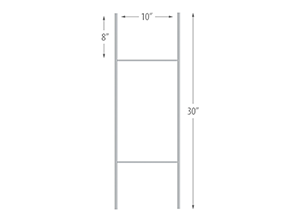
Read those three numbers as a spec sheet, because that is what they are.
- The 10 inch spread sets a minimum sign width. Both legs have to land inside the panel. The smallest sizes on the product page, 12 x 9 and 12 x 12, sit close to that limit, so check the orientation before you order a stack of them.
- The 8 inch insertion depth sets how much bite the sign gets. Eight inches of wire inside a flute is a lot of contact area, which is why a properly seated sign does not slide down the legs. It also sets a floor on panel height. A sign only 9 inches tall gives the legs almost nothing to spare, so on the shortest panels expect the stake to show above the top edge unless you seat it shallow. The 24 x 6 size is a rider or rail panel rather than a stake mount, because 6 inches cannot swallow an 8 inch leg at all.
- That leaves roughly 22 inches of stake below the panel. Some of it holds the sign clear of grass. The rest is what you push into the ground, and how much of it you actually bury is the single biggest factor in whether the sign is still standing tomorrow.
Now the part that quietly ruins sign orders. Corrugated plastic has flutes running one direction only, and a wire stake can only enter if those flutes run vertically. Coroplast, the sheet brand the sign trade is named after, is explicit that dimensions are quoted flute-relative: “When describing sheet sizes of Coroplast (an extrusion) we always give the across flutes dimension first, the length of the flute second.”
Citation capsule: Coroplast technical bulletin CSS-005-888 states: “When describing sheet sizes of Coroplast (an extrusion) we always give the across flutes dimension first, the length of the flute second.” The product overview in the same PDF describes the material as “a high impact polypropylene copolymer” extruded “with gauges ranging from 2mm to 10mm in thickness.” Source: Coroplast product overview and technical bulletin CSS-005-888, undated.
That convention describes how a mill labels a sheet, not how every sign shop labels a finished sign. So do not try to infer flute direction from the size dropdown. Just say it out loud on the order: these are stake mounted, so run the flutes vertically. It takes one sentence and it prevents a pallet of signs that no stake will go into. If you want the wider material picture first, our complete coroplast buyer’s guide covers thickness, finish, and outdoor life.
When is an A-frame the right call?
When there is no ground to stake into, or when you need the sign to move several times a day. An A-frame is two panels hinged at the top, standing on its own footprint. It does not care what is underneath as long as the surface is flat.
The situations where it beats a stake are specific and easy to spot:
- Paved entrances. Parking lot aprons, plazas, garage entries, loading zones. A stake has nothing to grab.
- Sidewalks and walkways on your own property. Registration, will-call, entry queues, restroom direction.
- Indoor use. Lobbies, gyms, halls, exhibit floors. Nobody stakes into a gym floor.
- Signs that relocate during the event. A frame you can pick up with one hand and set down forty feet away beats pulling and re-driving a stake.
- Anywhere digging is a bad idea. Irrigation lines, low voltage lighting, and drip tubing all live in the top few inches of a Houston landscape, and a wire leg finds them reliably.
The trade is honest and worth stating plainly. An A-frame costs more per location, takes real storage space, and is easier to walk off with than a wire stake pushed into a lawn. That is why the usual pattern for an event is a handful of A-frames at the fixed, high-value spots and a large run of staked signs everywhere else.
Houston Sign Company prints the coroplast panel, not the frame. If you already own A-frames, measure the insert opening and order panels cut to it, then add grommets so the panel can be strapped or zip tied in rather than relying on friction. Grommets are an option on the same product page as the stakes.
Where can you legally put each one in Houston?
On private property with the owner’s written consent, and essentially nowhere in the public right-of-way. This is where most event sign plans quietly break the law, and the penalty is different for the two mounts.
The City of Houston Sign Code, published separately as Chapter 46 of the Building Code, is direct. Section 4608(c)(1) makes it “unlawful to place a sign upon a public street, public sidewalk, public alley, public right-of-way, public curb or other public improvement in any public street or grounds” without express City Council consent. Section 4608(d) adds that “No person shall place a sign on private property without the written consent of the owner or agent for the owner of said private property.” Section 4608(f) bans signs on traffic islands outright, defining a traffic island narrowly as an area under 5,000 square feet bounded by curb lines, or any area with less than 50 feet between curb lines.
Then comes the line every campaign volunteer and event coordinator should read twice. Unlawful signs in the right-of-way are normally seized and held for up to 30 days so the owner can redeem them. Stake-type signs get no such courtesy. The exception names cloth, wood and paper rather than plastic, but it closes on “or similar lightweight materials,” and a coroplast panel on a wire stake is exactly what that phrase describes.
Citation capsule: Under the impoundment provisions of Section 4608(c)(2), the City of Houston Sign Code carries this exception: “Stake-type signs constructed of cloth, wood, paper or similar lightweight materials that are picked up in the right-of-way may be disposed of immediately, without regard to the foregoing impoundment provisions.” Source: City of Houston Sign Code, Chapter 46, Section 4608, current through Ordinance No. 2020-669, effective July 29, 2020.
Read that as a budgeting fact, not a legal footnote. A staked sign in the wrong strip of grass is not confiscated. It is gone. Plan your locations on land you have permission to use, get that permission in writing, and keep a copy with the crew placing signs.
One caveat on all of the above. The compilation quoted here is current through an ordinance effective July 29, 2020, and city code gets amended. Before a large or recurring placement, confirm the current text with the City of Houston Sign Administration rather than relying on an article.
A-frames on a public sidewalk carry a different problem: they narrow the path. The U.S. Access Board’s Public Right-of-Way Accessibility Guidelines, finalized in the Federal Register in August 2023, set the number at section R302.2: “the continuous clear width of pedestrian access routes shall be 48 inches (1220 mm) minimum, exclusive of the width of any curb.”
Citation capsule: PROWAG R302.2 requires a 48 inch minimum continuous clear width on pedestrian access routes, and R302.3 requires 60 by 60 inch passing spaces at intervals of no more than 200 feet where the route is narrower than 60 inches. Under the ADA Standards, the Access Board gives 36 inches as the minimum continuous clear width for an accessible route generally, narrowing to 32 inches only for short pinch points. Sources: U.S. Access Board, PROWAG technical requirements and U.S. Access Board, ADA guide to accessible routes.
Two different benchmarks for two different situations. PROWAG binds the public agencies that design and build sidewalks rather than the person setting out a sign, so treat 48 inches as the width you should leave on a public walk, not as a citation waiting to happen. On a private walkway leading to your entrance, the ADA Standards figure of 36 inches is the one to clear. Either way, measure the walk before you decide where the frame goes. A 36 inch A-frame on a 60 inch sidewalk leaves 24 inches, and 24 inches blocks a wheelchair.
Will it survive Houston wind?
Most sign failures here are not storm failures. They are gust failures on an ordinary day. The averages make Houston look gentle. NOAA’s long-term record for Bush Intercontinental, a 40 year period of record, puts the annual mean wind speed at 7.5 mph, with April the windiest month at 9.0 mph and August the calmest at 6.0 mph.
Averages are not what knocks signs over. The same NOAA record lists a maximum 3 second gust of 97 mph at that station, set in June 2023, and a maximum 2 minute wind of 48 mph. A sign spends most of its life in a 7.5 mph breeze and then meets a thunderstorm outflow for ninety seconds.
Neither mount is engineered or rated to a wind speed, and you should be suspicious of anyone who tells you otherwise. What does exist is the design principle the city applies to signs generally, in Section 4609(a)(1), which opens on “all signs and sign structures”: “The overturning moment produced from lateral forces shall in no case exceed two-thirds of the dead-load-resisting moment for all signs.”
Translated for an event coordinator, that is the whole physics of an A-frame in one sentence. Wind pushes on the face and tries to rotate the frame about its downwind foot. Weight and footprint resist that rotation. The bigger the panel and the lighter the frame, the closer you are to the tipping point, which is why ballast at the base of the frame is not optional on a windy day. For a staked sign, the equivalent question is buried depth, because that is where all the holding power lives.
Three practical adjustments that cost nothing:
- Bury more leg. Push the stake until the crossbar is near the ground, not until it feels snug. Half-driven stakes are the most common failure we see returned.
- Turn the panel edge-on to the prevailing wind where the message allows it. Houston’s annual prevailing wind direction at that station is 170 degrees, which is from the south.
- Water hard ground before staking. Gulf Coast clay in August takes a stake badly when it is baked and holds it badly when it is soaked. Damp is the target.
For context on how the panel itself holds up separately from the mount, see our breakdown of the best weatherproof materials for Houston yard signs.
How to spec a whole event sign run using both
Walk the route once, sort every location into three buckets, and count. This is the ten minute exercise that replaces guessing.
Bucket 1, soil on land you control. Stake it. Order one wire stake per sign and add ten percent for bent legs and locations you forgot. One Houston specific wrinkle: the city has no zoning, so on residential ground the binding rule is usually the subdivision’s deed restrictions or the HOA’s sign policy rather than anything in the city code. Ask the property manager before you plan a run through a neighborhood.
Bucket 2, hard surface on land you control. A-frame it. Count these carefully, because frames are the expensive line and you will reuse them next year. Order the panels sized to the frames you own.
Bucket 3, anything in the public right-of-way, on a traffic island, or on ground you do not control. Move it or get written permission. Do not treat this bucket as a gray area in Houston, because the sign code does not.
Then look at approach direction for each location. Signs that get read from two directions need two printed faces, and our guide to single sided versus double sided yard signs walks that decision. Signs on a bulk directional run usually do not.
One caution about digging, even shallow digging. Texas defines excavation by two tests at once, mechanized equipment and depth, and hand pressing a wire stake into a lawn meets neither, so the state’s one-call notice duty is not triggered.
Citation capsule: Texas Utilities Code Sec. 251.002 defines “Excavate” as “to use explosives or a motor, engine, hydraulic or pneumatically powered tool, or other mechanized equipment of any kind” including “auguring, backfilling, boring … trenching, and tunneling to remove or otherwise disturb soil to a depth of 16 or more inches.” Sec. 251.151 requires an excavator to notify a notification center no earlier than 14 days and no later than 48 hours before excavation begins. Source: Texas Utilities Code Sec. 251.002 and Sec. 251.151, current as of January 1, 2026.
That is a statement about the statute, not a promise about your site. Irrigation heads, low voltage lighting, and invisible fence wire routinely sit shallower than a stake leg reaches, so if you are staking dozens of signs on unfamiliar landscaped property, ask the property manager where the lines run before your crew starts pushing.
Does any of this pay for itself? The most cited consumer figure on signage comes from a FedEx Office telephone survey of 1,000 American adults conducted in March 2012, which reported that “almost eight in 10 (76 percent) American consumers enter a store they have never visited before based on its signs, and nearly seven in 10 (68 percent) have actually purchased a product or service because a sign caught their eye.” Treat it as directional and dated rather than as a forecast, since it predates most of how people navigate today. The operational point stands: a sign only does any of that while it is upright and readable, which is exactly what the mount decides.
How to order the panels
Order the panel first, the hardware as an option on the same line. Both mounts print on the same corrugated plastic sheet, so nothing about the artwork changes. This is what the sheet is built for. Inteplast’s IntePro product guide lists “election signs, pole signs, real estate signs” among the intended graphic arts applications for corrugated plastic, which is why the same panel serves a staked directional and an A-frame insert equally well.
Sizes available on the yard sign product page are 24 x 6, 12 x 9, 12 x 12, 18 x 12, 24 x 16, 24 x 18, 24 x 24, 36 x 24, and 48 x 48. Each order lets you set single or double sided, square cut or contour cut, wire stakes or no wire stakes, and grommets or no grommets. Pricing moves with size, quantity, and options, so check the live total on the product page rather than working from a number in an article. Political and election work runs through the matching campaign sign product page, and the Texas specific rules for that are covered in our 2026 Texas election year playbook.
Four things to specify in the order notes, none of which are automatic:
- Say the signs are stake mounted so the flutes run vertically.
- Add grommets on anything going into an A-frame or getting strapped to a fence or barricade.
- Order stakes as a separate count from signs if you are reusing last season’s hardware. You may need fewer than you think.
- Round the quantity up. The marginal sign costs far less than the drive back to cover a location you missed. Ten percent over your count is the usual insurance.
Sizing and quantity questions are covered in more depth in our yard signs buyer’s guide, and if your event is next week, see same day printing for Houston yard signs.
Frequently Asked Questions
Can I use an H-stake on hard-packed Houston clay?
Sometimes, and it is worth preparing for. Baked clay resists the wire and can bend a leg before it seats. Water the spot fifteen minutes ahead, or carry a screwdriver and a small mallet to open a pilot slot for each leg. If the ground defeats you at more than a couple of locations, switch those spots to A-frames rather than leaving half-driven stakes that will fall over.
What size sign fits a standard wire H-stake?
The stake we supply is 10 inches wide, so both legs must land inside the sign face. That makes 18 x 12, 24 x 18, and 24 x 16 the comfortable everyday sizes. The 12 x 9 and 12 x 12 panels sit close to the limit and need the 12 inch dimension running across the flutes. Panels 36 inches and wider usually want two stakes rather than one.
How deep should a yard sign stake go into the ground?
As deep as the design allows. The stake is 30 inches tall with 8 inches inside the sign, so roughly 22 inches sits below the panel. Push until the upper crossbar is close to the ground rather than stopping when it feels firm. Depth is where a staked sign’s entire wind resistance comes from.
Is it legal to put an A-frame on a Houston sidewalk?
Not on a public sidewalk without express City Council consent. The City of Houston Sign Code makes placing a sign on a public sidewalk or right-of-way unlawful, and it bans signs on traffic islands outright. On a private walkway you control, the constraint becomes accessibility: leave a continuous clear path, which federal guidelines put at 48 inches minimum for a public pedestrian access route and the ADA Standards put at 36 inches minimum for an accessible route.
What happens if the city finds my staked sign in the right-of-way?
You probably do not get it back. Signs found unlawfully in the right-of-way are normally impounded and held up to 30 days for redemption, but the sign code carries an exception allowing stake-type signs of lightweight materials to be disposed of immediately, with no impound period at all. Budget as if a misplaced sign is a lost sign.
Do A-frames need weight added in Houston?
On a breezy day, yes. Houston’s long-term mean wind speed is 7.5 mph, but the record 3 second gust at Bush Intercontinental is 97 mph, and thunderstorm outflow between those extremes is what tips frames. The city’s own design rule for signs holds that overturning moment must not exceed two-thirds of the dead-load-resisting moment, which in plain terms means weight and footprint are what keep a frame standing. Sandbags or water weights at the feet are cheap insurance.
Can the same printed sign go in both a stake and an A-frame?
Yes, if you plan for it. It is the same corrugated plastic panel either way. Order the size that matches your frame’s insert opening, run the flutes vertically so a wire stake can still enter, and add grommets so the panel can be strapped into the frame instead of relying on friction. One panel spec then covers both piles of locations.
Sources
- City of Houston Sign Code, Building Code Chapter 46, Sections 4608 and 4609, current through Ordinance No. 2020-669, effective July 29, 2020
- U.S. Access Board, PROWAG Chapter R3 technical requirements (R302.2 clear width, R302.3 passing spaces), final rule published August 8, 2023
- U.S. Access Board, ADA Standards guide to accessible routes
- NOAA NCEI, Local Climatological Data annual summary, Houston KIAH, 2023 (Normals, Means and Extremes table, mean wind speed over a 40 year period of record)
- Texas Utilities Code Sec. 251.002 (definition of “Excavate”) and Sec. 251.151 (duty of an excavator), current as of January 1, 2026
- Coroplast technical bulletins CSS-001, CSS-005-888 and CSS-011-93, undated
- Inteplast Group, IntePro corrugated plastic product guide, 2018
- FedEx Office, “What’s Your Sign?” consumer survey, May 14, 2012